Table Of Content

Or you might keep them for other reasons—not every minute of class time has to be spent on standards-based instruction. Some activities have value because they help us get to know each other better, they help students develop social-emotional skills, or they simply offer a bit of fun. But if a lesson doesn’t do any of these things, if it’s disguised as learning but is doing little more than keeping students busy, it’s time for it to go.
For Educators
In other words, if it does not align to a learning outcome, you probably do not need to include that content. To evaluate the success of a course, you must be able to observe the internal changes you identified in Step 1 happening in your students. So in Step 2, you create learning outcomes that describe how those internal changes will manifest externally. Your learning outcomes clarify exactly what it looks like for students to meet your learning goals. Learning outcomes should be specific and stated in concrete, observable, and measurable terms. If it turns out that those favorite lessons don’t really align with any standards, you might be able to revise them so they do.
Stage 3: Plan Learning Activities and Instructional Materials
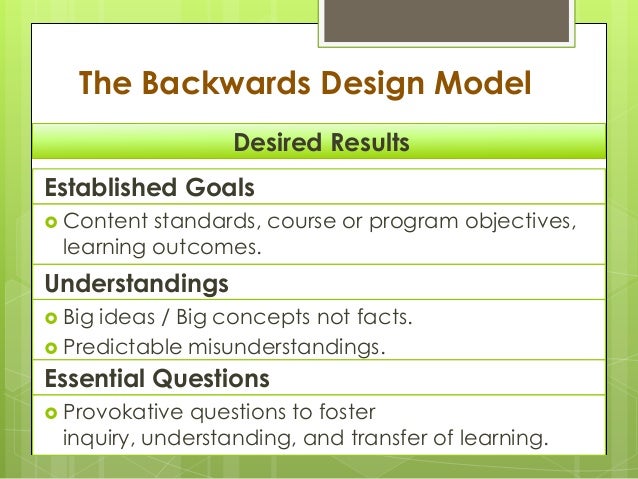
In other words, by figuring out how you want your students to end up, you’ll be better equipped and prepared to teach them the right things so they achieve those optimal outcomes. Backward design can be useful for professional educators and for anyone who teaches students, both online and in person. Explore education courses and certificates at the University of San Diego’s Division of Professional and Continuing Education. Learning outcomes describe what students know or can do, not what the instructor does.
In Corporate Training and Adult Education
Resources will be a pamphlet from the UDSA on food groups, the health textbook, and a video "Nutrition for You". Teaching methods will include direct instruction, inductive methods, cooperative learning, and group activities. Unlike in backward lesson design, the assessment here is created after the lessons. Therefore, a teacher could risk omitting certain facets of the lessons from the final assessment, only acknowledging in hindsight that they probably could have saved valuable class time by skipping certain units or activities.
Developing a backward design lesson plan step by step
Therefore, backward design is an effective way of providing guidance for instruction and designing lessons, units, and courses. Once the learning goals, or desired results, have been identified, instructors will have an easier time developing assessments and instruction around grounded learning outcomes. Therefore, backward design is an effective way of guiding instruction and designing lessons, units, and courses. Once the learning goals, or desired results, have been identified, instructors have an easier time developing assessments and instruction around grounded learning outcomes. The backward design approach to curriculum planning enables educators to provide goal-centered instruction. With learning objectives centered, students can appreciate the relevance of the instructional content.
From there, the instructor plans lectures, activities, and assignments to help students engage with that content. If those lectures, activities, and assignments are effective, students will learn something about the content. Depending on the quantity and quality of learning that results, the instructor might decide to try other teaching strategies the next time they teach the course. Backward design in a lesson plan means starting with the end objective, such as student-focused learning goals, and designing your assessments and learning materials afterward to ensure your students achieve those objectives.
7 Steps to Design a Basic Neural Network (part 2 of 2) - Towards Data Science
7 Steps to Design a Basic Neural Network (part 2 of .
Posted: Tue, 04 May 2021 07:00:00 GMT [source]
Contents
Once you have written a student-centered learning objective, and determined how you will assess your students, you are ready to plan the instructional strategies and activities you will implement. Instructional strategies are the methods by which you present new content to your students. This could be through direct instruction, demonstration, or cooperative learning, to name just a few. Instructional activities are the ways in which students will actually interact with the content.
Situated Learning Theory (Lave)
We're Driving The 2022 Mercedes C300 4MATIC, What Do You Want To Know? - CarScoops
We're Driving The 2022 Mercedes C300 4MATIC, What Do You Want To Know?.
Posted: Tue, 30 Aug 2022 07:00:00 GMT [source]
When an assessment is created after the lessons have taken place, a teacher risks covering course content that does not add value to the overall lesson or factor into the final assessment. Your backwards lesson planning should incorporate both instructional strategies and instructional activities. Academic standards usually provide the best direction for educational goals. For example, according to the Common Core Standards for Mathematical Practice, students should be able to understand the concept of ratios by the end of sixth grade. It is the teacher’s job to determine, via backward lesson design, how their students will reach the necessary level of proficiency.
In traditional curriculum planning, a list of content that will be taught is created and/or selected.[4] In backward design, the educator starts with goals, creates or plans out assessments and finally makes lesson plans. Supporters of backward design liken the process to using a "road map".[5] In this case, the destination is chosen first and then the road map is used to plan the trip to the desired destination. In contrast, in traditional curriculum planning there is no formal destination identified before the journey begins. Once you know the standards your students are expected to meet by a certain grade level, make a list of all the foundational knowledge they need to reach that goal.
We strive to ensure every Aboriginal and/or Torres Strait Islander learner in NSW achieves their potential through education. Critics of backward design express concerns around a potential lack of flexibility in programming. Teachers may fear “teaching to the test” and not enabling authentic learning. Education authorities establish a curriculum in a top-down manner that may not fully address the circumstances in a classroom. In cognitive psychology, cognitive load refers to the amount of resources in working memory that are being used by students for processing and encoding new information. We understand that some level of difficulty and challenge is beneficial during the learning process, but when cognitive load is too high, frustrations rise, comprehension suffers, and some students give up completely.
Wiggins and McTighe have created a six-part checklist built on the acronym WHERETO that consists of key elements that should be included in your instructional materials and learning activities. When using the Step-by-Step Guide below to plan your course, you'll want to keep your ideas organized. A Course Plan template like the one pictured here helps you outline your course week-by-week, articulate how you will sequence course content, and solidify the timing of learning activities over the semester. Complete the columns of the template in order as you proceed through each step of backward design.
By focusing on the end goals you want to achieve, then emphasizing assessment types and content, you ensure that your lessons will always teach students what they need to know to pass tests. Furthermore, when a teacher designs a lesson without a plan for the final assessment, they may be tempted to add activities or units to the lesson just for the sake of filling class time. Students of all ages know when they are asked to do something pointless in class; they can spot “busy work” from a mile away, and will disengage as they see fit. The scope of your assessments should be in line with the outcomes, and the balance between concepts and skills in these assessments should match that presented in your ILOs. Moreover, in assessments, you should strive to measure the kind(s) of engagement described in your intended learning outcomes.
When developing ILOs, ask yourself how you will know that a student “understands” the material – what will they need to do, or say to demonstrate their understanding? Your answer to this question should provide you with more specific (and measurable ILOs. Assessments must be aligned to the learning goals that have been identified in Stage 1. With this type of assessment, it should be noted that preparing rubrics and checklists will be necessary to score consistently and track student learning. In choosing the strategies for your course, then, it is important to consider the levels of thinking, understanding, and reasoning that will best serve your desired learning goals for the course. On the other hand, if one of your important goals is to help students develop their ability to master mechanical tools, a problem-solving test may not provide you with the type of evidence of progress that you require.
Understanding how it compares to other frameworks helps educators make more informed choices about which approach to use in different teaching and learning contexts. Grant Wiggins and Jay McTighe introduced backward design in their book Understanding by Design. In contrast to the traditional “forward design” approach, backward design begins by establishing learning goals and then developing assessments and teaching methods to achieve the desired outcomes.
While PBL and Backward Design both stress the importance of real-world applications, they differ in structure. PBL is generally more open-ended and may not align neatly with specific learning objectives. For instance, it's difficult to set specific, narrow learning goals for interdisciplinary courses like “Environmental Science” that integrate biology, chemistry, and social science. The challenge lies in encapsulating the breadth of these disciplines into a set of focused objectives without diluting the complexity and richness of the subject matter. So whether you're in a classroom filled with children, a university lecture hall, or a corporate training room, Backward Design offers a structured and effective way to reach your learning goals. This approach is flexible enough to be customized for any educational context.


No comments:
Post a Comment